[1] │ Home: <5><0><7>-<6><4><5>-<5><4><8><9>Text Analysis
Day 14
Prof Emily Kurtz
Carleton College
Stat 220 - Spring 2026
Today
- Finish Regex
- Intro to Text Analysis
Regular Expressions (regex)
Regular expressions
Last time, we discussed
str_view() - finds regex matches
Specifications:
. - match any character
[] - match any occurence
[^] match any occurence except
and more! Including special patterns, anchors, and quantifiers
Special patterns
There are a number of special patterns that match more than one character
\\d- digit\\s- white space\\w- word\\t- tab\\n- newline
Special patterns
Caution!
Anchors
Anchors look for matches at the start ^ or end $
[1] │ Home: 507-645-5489
[2] │ Cell: 219.917.9871
[3] │ My work phone is 507-202-2332
[4] │ I don't have a phoneYour turn
A vector called words is loaded with stringr and contains a corpus of 980 words used in text analysis. Use stringr functions and regular expressions to find the words that satisfy the following descriptions.
1. Find all words that start with y.
2. Find all words that end with x.
3. Find all words that start with a vowel.
4. Find all words that start with consonants.
Alternative patterns
| allows you to match one or more alternative patterns
We want full state abbreviations that start with either A or C
“Fixing” the order of operations
Why are these different?
Quantifiers
You can search for a pattern that appears a certain number of times in a row
Your turn:
Go to regex101.com. Type your regex under “Regular Expression,” your string under “Test String,” and use the “Quick Reference” section as a cheat sheet if needed.
We are going to test whether two names, Alexander and Aaron, have two a’s
- First, test whether each has an a. Also test whether each has an A. Notice the difference in what is highlighted under Test String. How could you test for both a and A at the same time? You should get two matches for both names under “Match Information.”
- Now, test whether each name has two a’s - make sure your test takes into account both lower and upper case a’s. You should get a single match for both names under Match Information.
Takeaways
Regex plays well with our stringr functions
regex101.com can help you troubleshoot your regex patterns if you’re getting something unexpected in R
Intro to Text Analysis
Text Analysis
Up to this point, we’ve been thinking of string data as a column in our dataset:
- Names
- Phone numbers
- Addresses
- Course titles
- etc.
which are all relatively short and structured. We can extract meaning from them using relatively simple functions and “know what we’re looking for”.
Sometimes, text data is more unstructured
Random (?) sample of 26,882 reviews of coursera courses
# A tibble: 26,882 × 5
   CourseId                    Review                      Label cld2  review_id
   <chr>                       <chr>                       <dbl> <chr>     <dbl>
 1 nurture-market-strategies   It would be better if the …     1 en            1
 2 nand2tetris2                Superb course. Great prese…     5 en            2
 3 schedule-projects           Excellent course!               5 en            3
 4 teaching-english-capstone-2 I'd recommend this course …     5 en            4
 5 machine-learning            This course was so effecti…     5 en            5
 6 python-network-data         Words cannot describe how …     5 en            6
 7 clinical-trials             Great course!                   5 en            7
 8 python-genomics             I didn't know anything abo…     3 en            8
 9 strategic-management        Loved everything about thi…     5 en            9
10 script-writing              No significant instruction…     1 en           10
# ℹ 26,872 more rows
Note: may need to install tidytext and stopwords packages
Sometimes, text data is more unstructured
[1] "So first of all, the material for this course in the bookdown document are very good - well structured, with good sources. My concern is that the Coursera course does not go a lot beyond, basically just referring to the document and adding quizzes + graded assignment in the last week. The assignment, however, is nice and challenging and requires people to understand the materials.Also, the course covers other great packages than ggplot2, e.g. plotly and leaflet and methods for handling spatial data. I think it would be very nice if the students were challenged in these topics as well and evaluate them in a better way than just a quiz (programming assignment for instance).I liked the course though and I believe it can be prepared even better."
[2] "Good course on plotting libraries and useful plots in R. Wished there was more coverage of ggplot and less on lattice, but overall a useful course."
[3] "Good Intro to R.Basics of ggplot2 should have been covered along with base graphs or as a separate unit"
[4] "Interesting, information-dense and well presented lectures by someone who obviously has a deep understanding of the topics and who is passionate about teaching the subject. Added to that: a great course textbook and useful R tutorials with a focus on commonly used libraries such as dplyr and ggplot. Beginner and intermediate statistics students, as well as teachers interested in the presentation of statistics theory and practice, can't go wrong with this course."
[5] "ggplot2 module was extremely helpful"
[6] "This course provides a great overiew to introductory R programming. Since taking the course, I have successfully used the precepts learned here for a number of analysis projects. Coupled with ggplot2 graphics, the results became self-evident."
[7] "Lecture videos were fantastic! Instructor was amazing. I have a big problem with the final project in Week 5. The entire courses was focused on statistics, yet the final project was focused on R. I wish I had prior R knowledge before starting this course, yet on the front page it says it's a beginner specialization. I would recommend learning R and ggplot before this course. It will make the course a lot less frustrating!"
[8] "Overall, I would recommend this class. I found that the preparation towards the final project could use some improvement, especially plotting using the 'ggplot2' package. Why not work on this during Week 4 through an assignment that works on this? This would have made it easier to focus on the research questions of the project and less on the graph making mechanics. Also, I found that the project was a little bit too open-ended and could have used some more input from the instructors' side. The material during the four weeks of the course was really good and thorough but perhaps a little too difficult to follow for people who have absolutely no background in probability theory. Maybe one should audit the course first and then decide whether it would be a good idea to formally enroll."
Some notation
document: an observation of text data (in this case, a review)
corpus: collection of many documents
token: a unit of analysis within the document (typically a word, but could be a sentence or a line or a pair of words, etc.)
Text as tidy data
- tokenize each document
- Each row in the dataset is a token
- Remove stopwords
- Words like “the” and “is” typically aren’t interesting
- Makes the dataset smaller and easier to work with
- Count the tokens
- (optional) fancy count the tokens
- Standardize based on total number of tokens
- How common is a token relative to other documents
- How common are “good words” or “bad words”
unnest_tokens()
tbl: our dataoutput: what should the output column be called?input: what column do we tokenize?token: default is “word” but can also be “ngrams”, “sentences”, “lines”, “paragraphs”, etc.to_lower: should tokens be converted to lowercase
Tokenize
# A tibble: 666,539 × 2
   CourseId                  word
   <chr>                     <chr>
 1 nurture-market-strategies it
 2 nurture-market-strategies would
 3 nurture-market-strategies be
 4 nurture-market-strategies better
 5 nurture-market-strategies if
 6 nurture-market-strategies the
 7 nurture-market-strategies instructors
 8 nurture-market-strategies cared
 9 nurture-market-strategies to
10 nurture-market-strategies respond
# ℹ 666,529 more rows
Stopwords
[1] "'ll" "'tis" "'twas" "'ve"
[5] "10" "39" "a" "a's"
[9] "able" "ableabout" "about" "above"
[13] "abroad" "abst" "accordance" "according"
[17] "accordingly" "across" "act" "actually"
[21] "ad" "added" "adj" "adopted"
[25] "ae" "af" "affected" "affecting"
[29] "affects" "after" "afterwards" "ag"
[33] "again" "against" "ago" "ah"
[37] "ahead" "ai" "ain't" "aint"
[41] "al" "all" "allow" "allows"
[45] "almost" "alone" "along" "alongside"
[49] "already" "also" "although" "always"
[53] "am" "amid" "amidst" "among"
[57] "amongst" "amoungst" "amount" "an"
[61] "and" "announce" "another" "any"
[65] "anybody" "anyhow" "anymore" "anyone"
[69] "anything" "anyway" "anyways" "anywhere"
[73] "ao" "apart" "apparently" "appear"
[77] "appreciate" "appropriate" "approximately" "aq"
[81] "ar" "are" "area" "areas"
[85] "aren" "aren't" "arent" "arise"
[89] "around" "arpa" "as" "aside"
[93] "ask" "asked" "asking" "asks"
[97] "associated" "at" "au" "auth"
[101] "available" "aw" "away" "awfully"
[105] "az" "b" "ba" "back"
[109] "backed" "backing" "backs" "backward"
[113] "backwards" "bb" "bd" "be"
[117] "became" "because" "become" "becomes"
[121] "becoming" "been" "before" "beforehand"
[125] "began" "begin" "beginning" "beginnings"
[129] "begins" "behind" "being" "beings"
[133] "believe" "below" "beside" "besides"
[137] "best" "better" "between" "beyond"
[141] "bf" "bg" "bh" "bi"
[145] "big" "bill" "billion" "biol"
[149] "bj" "bm" "bn" "bo"
[153] "both" "bottom" "br" "brief"
[157] "briefly" "bs" "bt" "but"
[161] "buy" "bv" "bw" "by"
[165] "bz" "c" "c'mon" "c's"
[169] "ca" "call" "came" "can"
[173] "can't" "cannot" "cant" "caption"
[177] "case" "cases" "cause" "causes"
[181] "cc" "cd" "certain" "certainly"
[185] "cf" "cg" "ch" "changes"
[189] "ci" "ck" "cl" "clear"
[193] "clearly" "click" "cm" "cmon"
[197] "cn" "co" "co." "com"
[201] "come" "comes" "computer" "con"
[205] "concerning" "consequently" "consider" "considering"
[209] "contain" "containing" "contains" "copy"
[213] "corresponding" "could" "could've" "couldn"
[217] "couldn't" "couldnt" "course" "cr"
[221] "cry" "cs" "cu" "currently"
[225] "cv" "cx" "cy" "cz"
[229] "d" "dare" "daren't" "darent"
[233] "date" "de" "dear" "definitely"
[237] "describe" "described" "despite" "detail"
[241] "did" "didn" "didn't" "didnt"
[245] "differ" "different" "differently" "directly"
[249] "dj" "dk" "dm" "do"
[253] "does" "doesn" "doesn't" "doesnt"
[257] "doing" "don" "don't" "done"
[261] "dont" "doubtful" "down" "downed"
[265] "downing" "downs" "downwards" "due"
[269] "during" "dz" "e" "each"
[273] "early" "ec" "ed" "edu"
[277] "ee" "effect" "eg" "eh"
[281] "eight" "eighty" "either" "eleven"
[285] "else" "elsewhere" "empty" "end"
[289] "ended" "ending" "ends" "enough"
[293] "entirely" "er" "es" "especially"
[297] "et" "et-al" "etc" "even"
[301] "evenly" "ever" "evermore" "every"
[305] "everybody" "everyone" "everything" "everywhere"
[309] "ex" "exactly" "example" "except"
[313] "f" "face" "faces" "fact"
[317] "facts" "fairly" "far" "farther"
[321] "felt" "few" "fewer" "ff"
[325] "fi" "fifteen" "fifth" "fifty"
[329] "fify" "fill" "find" "finds"
[333] "fire" "first" "five" "fix"
[337] "fj" "fk" "fm" "fo"
[341] "followed" "following" "follows" "for"
[345] "forever" "former" "formerly" "forth"
[349] "forty" "forward" "found" "four"
[353] "fr" "free" "from" "front"
[357] "full" "fully" "further" "furthered"
[361] "furthering" "furthermore" "furthers" "fx"
[365] "g" "ga" "gave" "gb"
[369] "gd" "ge" "general" "generally"
[373] "get" "gets" "getting" "gf"
[377] "gg" "gh" "gi" "give"
[381] "given" "gives" "giving" "gl"
[385] "gm" "gmt" "gn" "go"
[389] "goes" "going" "gone" "good"
[393] "goods" "got" "gotten" "gov"
[397] "gp" "gq" "gr" "great"
[401] "greater" "greatest" "greetings" "group"
[405] "grouped" "grouping" "groups" "gs"
[409] "gt" "gu" "gw" "gy"
[413] "h" "had" "hadn't" "hadnt"
[417] "half" "happens" "hardly" "has"
[421] "hasn" "hasn't" "hasnt" "have"
[425] "haven" "haven't" "havent" "having"
[429] "he" "he'd" "he'll" "he's"
[433] "hed" "hell" "hello" "help"
[437] "hence" "her" "here" "here's"
[441] "hereafter" "hereby" "herein" "heres"
[445] "hereupon" "hers" "herself" "herse”"
[449] "hes" "hi" "hid" "high"
[453] "higher" "highest" "him" "himself"
[457] "himse”" "his" "hither" "hk"
[461] "hm" "hn" "home" "homepage"
[465] "hopefully" "how" "how'd" "how'll"
[469] "how's" "howbeit" "however" "hr"
[473] "ht" "htm" "html" "http"
[477] "hu" "hundred" "i" "i'd"
[481] "i'll" "i'm" "i've" "i.e."
[485] "id" "ie" "if" "ignored"
[489] "ii" "il" "ill" "im"
[493] "immediate" "immediately" "importance" "important"
[497] "in" "inasmuch" "inc" "inc."
[501] "indeed" "index" "indicate" "indicated"
[505] "indicates" "information" "inner" "inside"
[509] "insofar" "instead" "int" "interest"
[513] "interested" "interesting" "interests" "into"
[517] "invention" "inward" "io" "iq"
[521] "ir" "is" "isn" "isn't"
[525] "isnt" "it" "it'd" "it'll"
[529] "it's" "itd" "itll" "its"
[533] "itself" "itse”" "ive" "j"
[537] "je" "jm" "jo" "join"
[541] "jp" "just" "k" "ke"
[545] "keep" "keeps" "kept" "keys"
[549] "kg" "kh" "ki" "kind"
[553] "km" "kn" "knew" "know"
[557] "known" "knows" "kp" "kr"
[561] "kw" "ky" "kz" "l"
[565] "la" "large" "largely" "last"
[569] "lately" "later" "latest" "latter"
[573] "latterly" "lb" "lc" "least"
[577] "length" "less" "lest" "let"
[581] "let's" "lets" "li" "like"
[585] "liked" "likely" "likewise" "line"
[589] "little" "lk" "ll" "long"
[593] "longer" "longest" "look" "looking"
[597] "looks" "low" "lower" "lr"
[601] "ls" "lt" "ltd" "lu"
[605] "lv" "ly" "m" "ma"
[609] "made" "mainly" "make" "makes"
[613] "making" "man" "many" "may"
[617] "maybe" "mayn't" "maynt" "mc"
[621] "md" "me" "mean" "means"
[625] "meantime" "meanwhile" "member" "members"
[629] "men" "merely" "mg" "mh"
[633] "microsoft" "might" "might've" "mightn't"
[637] "mightnt" "mil" "mill" "million"
[641] "mine" "minus" "miss" "mk"
[645] "ml" "mm" "mn" "mo"
[649] "more" "moreover" "most" "mostly"
[653] "move" "mp" "mq" "mr"
[657] "mrs" "ms" "msie" "mt"
[661] "mu" "much" "mug" "must"
[665] "must've" "mustn't" "mustnt" "mv"
[669] "mw" "mx" "my" "myself"
[673] "myse”" "mz" "n" "na"
[677] "name" "namely" "nay" "nc"
[681] "nd" "ne" "near" "nearly"
[685] "necessarily" "necessary" "need" "needed"
[689] "needing" "needn't" "neednt" "needs"
[693] "neither" "net" "netscape" "never"
[697] "neverf" "neverless" "nevertheless" "new"
[701] "newer" "newest" "next" "nf"
[705] "ng" "ni" "nine" "ninety"
[709] "nl" "no" "no-one" "nobody"
[713] "non" "none" "nonetheless" "noone"
[717] "nor" "normally" "nos" "not"
[721] "noted" "nothing" "notwithstanding" "novel"
[725] "now" "nowhere" "np" "nr"
[729] "nu" "null" "number" "numbers"
[733] "nz" "o" "obtain" "obtained"
[737] "obviously" "of" "off" "often"
[741] "oh" "ok" "okay" "old"
[745] "older" "oldest" "om" "omitted"
[749] "on" "once" "one" "one's"
[753] "ones" "only" "onto" "open"
[757] "opened" "opening" "opens" "opposite"
[761] "or" "ord" "order" "ordered"
[765] "ordering" "orders" "org" "other"
[769] "others" "otherwise" "ought" "oughtn't"
[773] "oughtnt" "our" "ours" "ourselves"
[777] "out" "outside" "over" "overall"
[781] "owing" "own" "p" "pa"
[785] "page" "pages" "part" "parted"
[789] "particular" "particularly" "parting" "parts"
[793] "past" "pe" "per" "perhaps"
[797] "pf" "pg" "ph" "pk"
[801] "pl" "place" "placed" "places"
[805] "please" "plus" "pm" "pmid"
[809] "pn" "point" "pointed" "pointing"
[813] "points" "poorly" "possible" "possibly"
[817] "potentially" "pp" "pr" "predominantly"
[821] "present" "presented" "presenting" "presents"
[825] "presumably" "previously" "primarily" "probably"
[829] "problem" "problems" "promptly" "proud"
[833] "provided" "provides" "pt" "put"
[837] "puts" "pw" "py" "q"
[841] "qa" "que" "quickly" "quite"
[845] "qv" "r" "ran" "rather"
[849] "rd" "re" "readily" "really"
[853] "reasonably" "recent" "recently" "ref"
[857] "refs" "regarding" "regardless" "regards"
[861] "related" "relatively" "research" "reserved"
[865] "respectively" "resulted" "resulting" "results"
[869] "right" "ring" "ro" "room"
[873] "rooms" "round" "ru" "run"
[877] "rw" "s" "sa" "said"
[881] "same" "saw" "say" "saying"
[885] "says" "sb" "sc" "sd"
[889] "se" "sec" "second" "secondly"
[893] "seconds" "section" "see" "seeing"
[897] "seem" "seemed" "seeming" "seems"
[901] "seen" "sees" "self" "selves"
[905] "sensible" "sent" "serious" "seriously"
[909] "seven" "seventy" "several" "sg"
[913] "sh" "shall" "shan't" "shant"
[917] "she" "she'd" "she'll" "she's"
[921] "shed" "shell" "shes" "should"
[925] "should've" "shouldn" "shouldn't" "shouldnt"
[929] "show" "showed" "showing" "shown"
[933] "showns" "shows" "si" "side"
[937] "sides" "significant" "significantly" "similar"
[941] "similarly" "since" "sincere" "site"
[945] "six" "sixty" "sj" "sk"
[949] "sl" "slightly" "sm" "small"
[953] "smaller" "smallest" "sn" "so"
[957] "some" "somebody" "someday" "somehow"
[961] "someone" "somethan" "something" "sometime"
[965] "sometimes" "somewhat" "somewhere" "soon"
[969] "sorry" "specifically" "specified" "specify"
[973] "specifying" "sr" "st" "state"
[977] "states" "still" "stop" "strongly"
[981] "su" "sub" "substantially" "successfully"
[985] "such" "sufficiently" "suggest" "sup"
[989] "sure" "sv" "sy" "system"
[993] "sz" "t" "t's" "take"
[997] "taken" "taking" "tc" "td"
[1001] "tell" "ten" "tends" "test"
[1005] "text" "tf" "tg" "th"
[1009] "than" "thank" "thanks" "thanx"
[1013] "that" "that'll" "that's" "that've"
[1017] "thatll" "thats" "thatve" "the"
[1021] "their" "theirs" "them" "themselves"
[1025] "then" "thence" "there" "there'd"
[1029] "there'll" "there're" "there's" "there've"
[1033] "thereafter" "thereby" "thered" "therefore"
[1037] "therein" "therell" "thereof" "therere"
[1041] "theres" "thereto" "thereupon" "thereve"
[1045] "these" "they" "they'd" "they'll"
[1049] "they're" "they've" "theyd" "theyll"
[1053] "theyre" "theyve" "thick" "thin"
[1057] "thing" "things" "think" "thinks"
[1061] "third" "thirty" "this" "thorough"
[1065] "thoroughly" "those" "thou" "though"
[1069] "thoughh" "thought" "thoughts" "thousand"
[1073] "three" "throug" "through" "throughout"
[1077] "thru" "thus" "til" "till"
[1081] "tip" "tis" "tj" "tk"
[1085] "tm" "tn" "to" "today"
[1089] "together" "too" "took" "top"
[1093] "toward" "towards" "tp" "tr"
[1097] "tried" "tries" "trillion" "truly"
[1101] "try" "trying" "ts" "tt"
[1105] "turn" "turned" "turning" "turns"
[1109] "tv" "tw" "twas" "twelve"
[1113] "twenty" "twice" "two" "tz"
[1117] "u" "ua" "ug" "uk"
[1121] "um" "un" "under" "underneath"
[1125] "undoing" "unfortunately" "unless" "unlike"
[1129] "unlikely" "until" "unto" "up"
[1133] "upon" "ups" "upwards" "us"
[1137] "use" "used" "useful" "usefully"
[1141] "usefulness" "uses" "using" "usually"
[1145] "uucp" "uy" "uz" "v"
[1149] "va" "value" "various" "vc"
[1153] "ve" "versus" "very" "vg"
[1157] "vi" "via" "viz" "vn"
[1161] "vol" "vols" "vs" "vu"
[1165] "w" "want" "wanted" "wanting"
[1169] "wants" "was" "wasn" "wasn't"
[1173] "wasnt" "way" "ways" "we"
[1177] "we'd" "we'll" "we're" "we've"
[1181] "web" "webpage" "website" "wed"
[1185] "welcome" "well" "wells" "went"
[1189] "were" "weren" "weren't" "werent"
[1193] "weve" "wf" "what" "what'd"
[1197] "what'll" "what's" "what've" "whatever"
[1201] "whatll" "whats" "whatve" "when"
[1205] "when'd" "when'll" "when's" "whence"
[1209] "whenever" "where" "where'd" "where'll"
[1213] "where's" "whereafter" "whereas" "whereby"
[1217] "wherein" "wheres" "whereupon" "wherever"
[1221] "whether" "which" "whichever" "while"
[1225] "whilst" "whim" "whither" "who"
[1229] "who'd" "who'll" "who's" "whod"
[1233] "whoever" "whole" "wholl" "whom"
[1237] "whomever" "whos" "whose" "why"
[1241] "why'd" "why'll" "why's" "widely"
[1245] "width" "will" "willing" "wish"
[1249] "with" "within" "without" "won"
[1253] "won't" "wonder" "wont" "words"
[1257] "work" "worked" "working" "works"
[1261] "world" "would" "would've" "wouldn"
[1265] "wouldn't" "wouldnt" "ws" "www"
[1269] "x" "y" "ye" "year"
[1273] "years" "yes" "yet" "you"
[1277] "you'd" "you'll" "you're" "you've"
[1281] "youd" "youll" "young" "younger"
[1285] "youngest" "your" "youre" "yours"
[1289] "yourself" "yourselves" "youve" "yt"
[1293] "yu" "z" "za" "zero"
[1297] "zm" "zr" anti_join
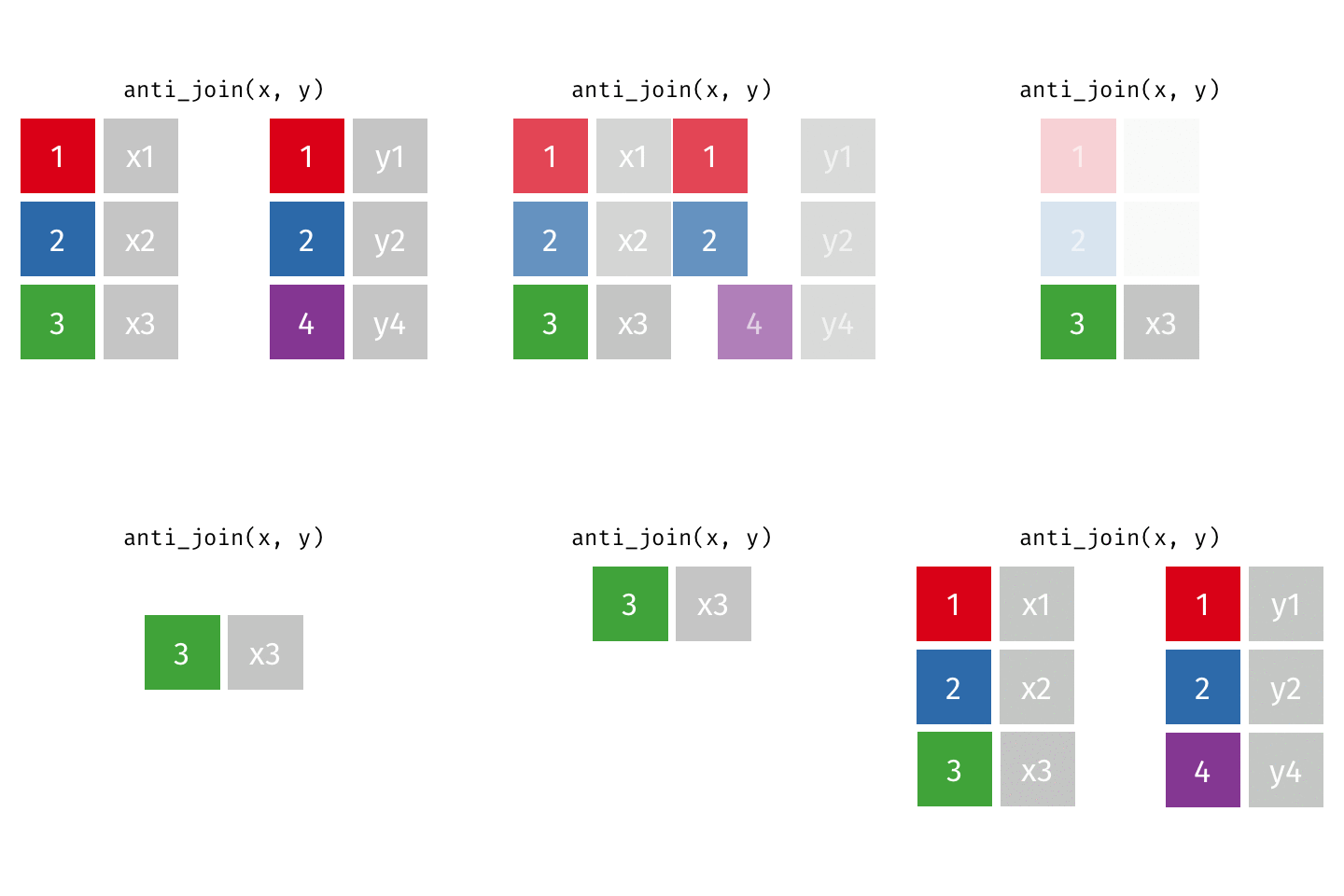
Remove stopwords
# A tibble: 222,601 × 2
   CourseId                  word
   <chr>                     <chr>
 1 nurture-market-strategies instructors
 2 nurture-market-strategies cared
 3 nurture-market-strategies respond
 4 nurture-market-strategies queries
 5 nand2tetris2              superb
 6 nand2tetris2              presentation
 7 nand2tetris2              material
 8 nand2tetris2              projects
 9 nand2tetris2              challenging
10 nand2tetris2              fun
# ℹ 222,591 more rows
Filter to include only data science courses
# A tibble: 1,419 × 2
   CourseId                        word
   <chr>                           <chr>
 1 data-science-course             helpful
 2 data-science-course             paced
 3 executive-data-science-capstone quality
 4 executive-data-science-capstone fun
 5 data-science-course             level
 6 data-science-course             overview
 7 data-science-course             technical
 8 data-science-course             introduction
 9 data-science-course             essential
10 data-science-course             key
# ℹ 1,409 more rows
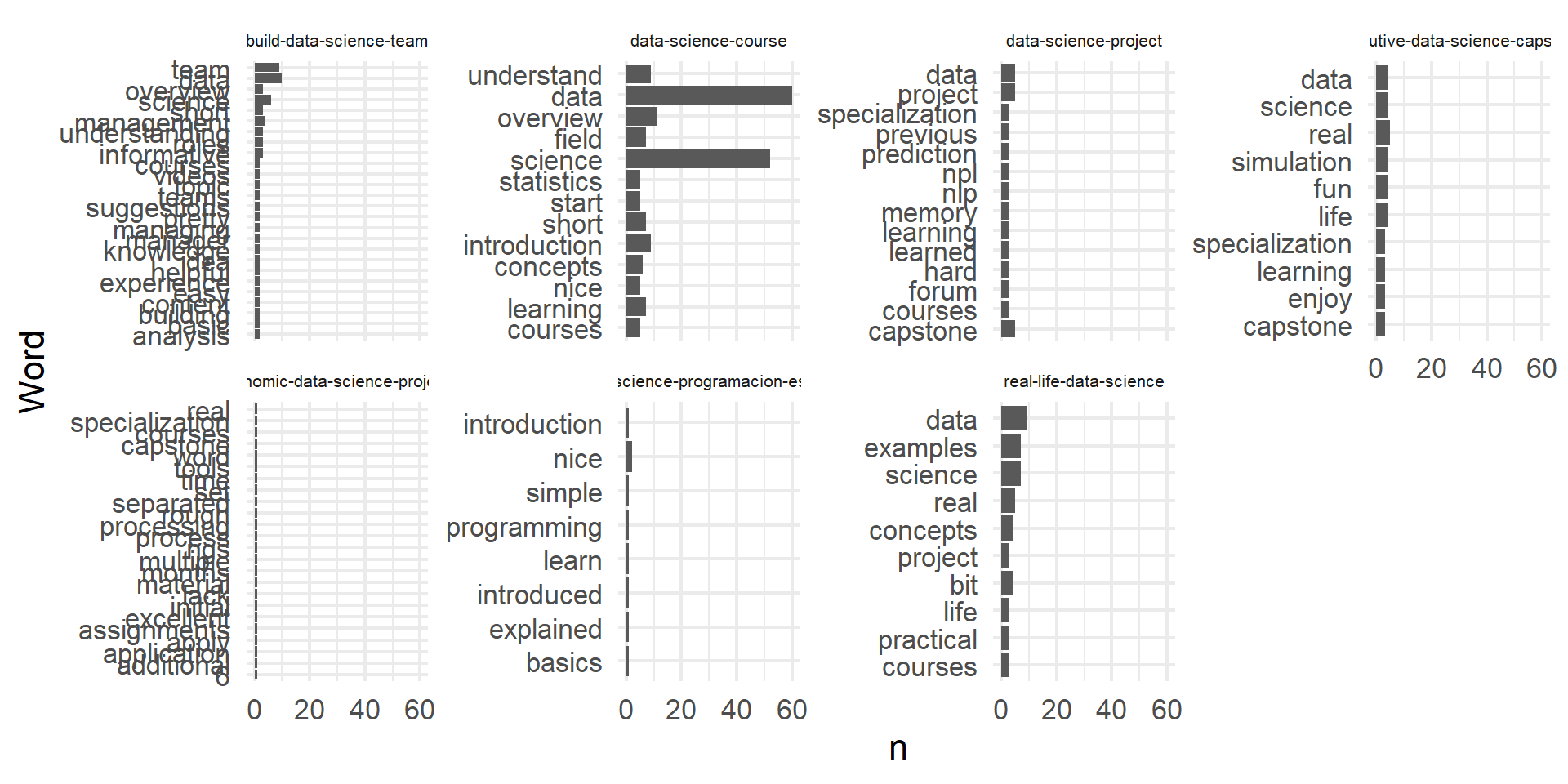
Count the tokens, show most common by course id
en_coursera_reviews |>
  unnest_tokens(output = word, input = Review) |>
  anti_join(get_stopwords(source = "stopwords-iso"), by = "word") |>
  filter(str_detect(CourseId, "data-science")) |>
  group_by(CourseId) %>%
  count(word) %>%
  slice_max(n, n = 10) %>%
  ggplot(aes(x = n, y = fct_reorder(word, n))) +
  geom_col() +
  facet_wrap(~CourseId, scales = "free_y", nrow = 2) +
  labs(
    y = "Word"
  ) +
  theme(strip.text = element_text(size = 8))
Count the tokens, show most common by course id
Make it ~ fancy ~: n-grams
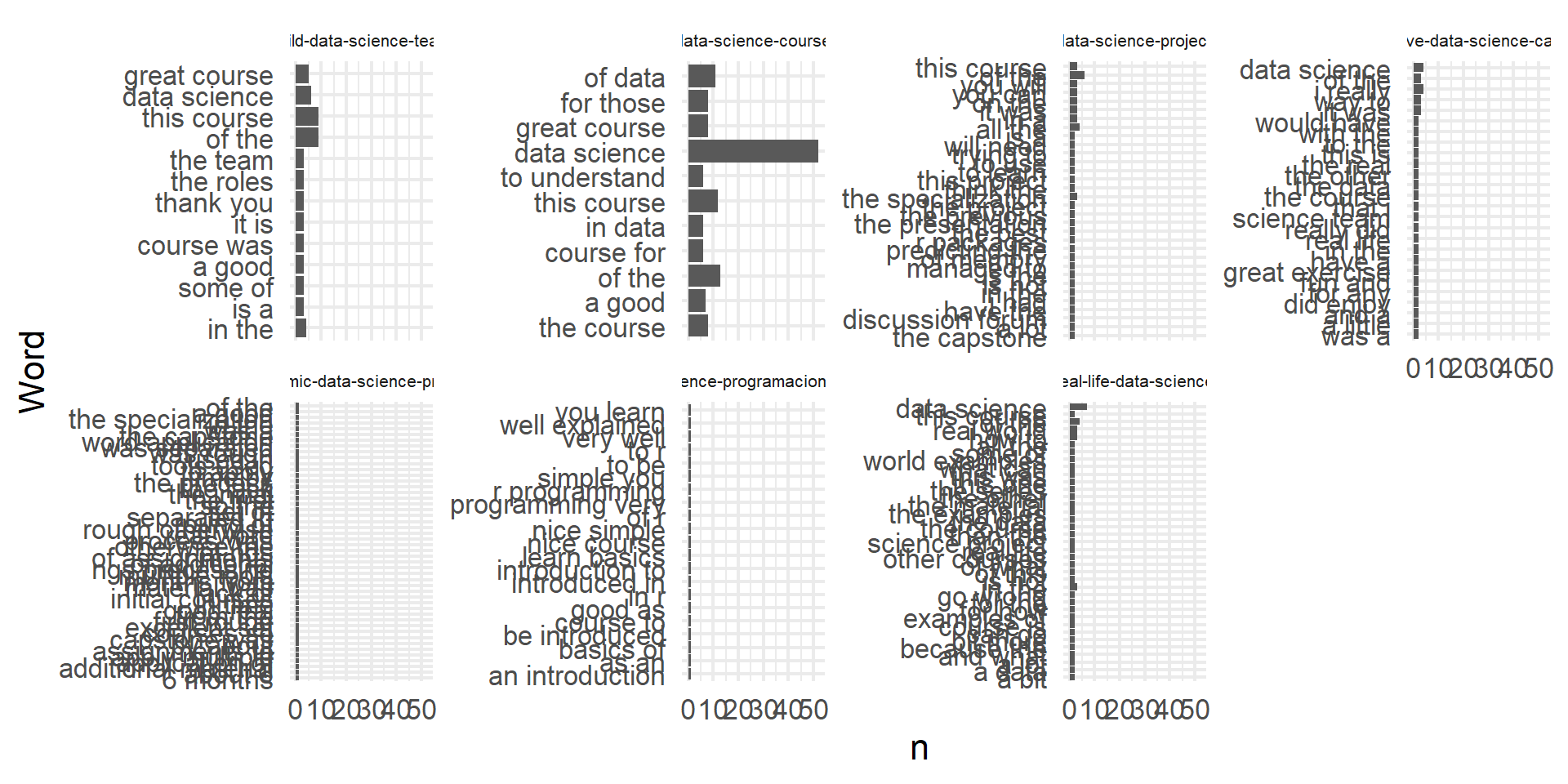
Make it ~ fancy ~: n-grams
en_coursera_reviews |>
  unnest_tokens(output = word, input = Review, token = "ngrams", n=2) |>
  anti_join(get_stopwords(source = "stopwords-iso"), by = "word") |>
  filter(str_detect(CourseId, "data-science")) |>
  group_by(CourseId) %>%
  count(word) %>%
  slice_max(n, n = 10) %>%
  ggplot(aes(x = n, y = fct_reorder(word, n))) +
  geom_col() +
  facet_wrap(~CourseId, scales = "free_y", nrow = 2) +
  labs(
    y = "Word"
  ) +
  theme(strip.text = element_text(size = 8))
Make it ~ fancy ~: n-grams
Removing stopwords from reviews first
Original Review:
What if we use a different stopwords dictionary?
Original Review:
[1] "Words cannot describe how useful this courses have been for me, 10 stars if possible!"Clean Review:
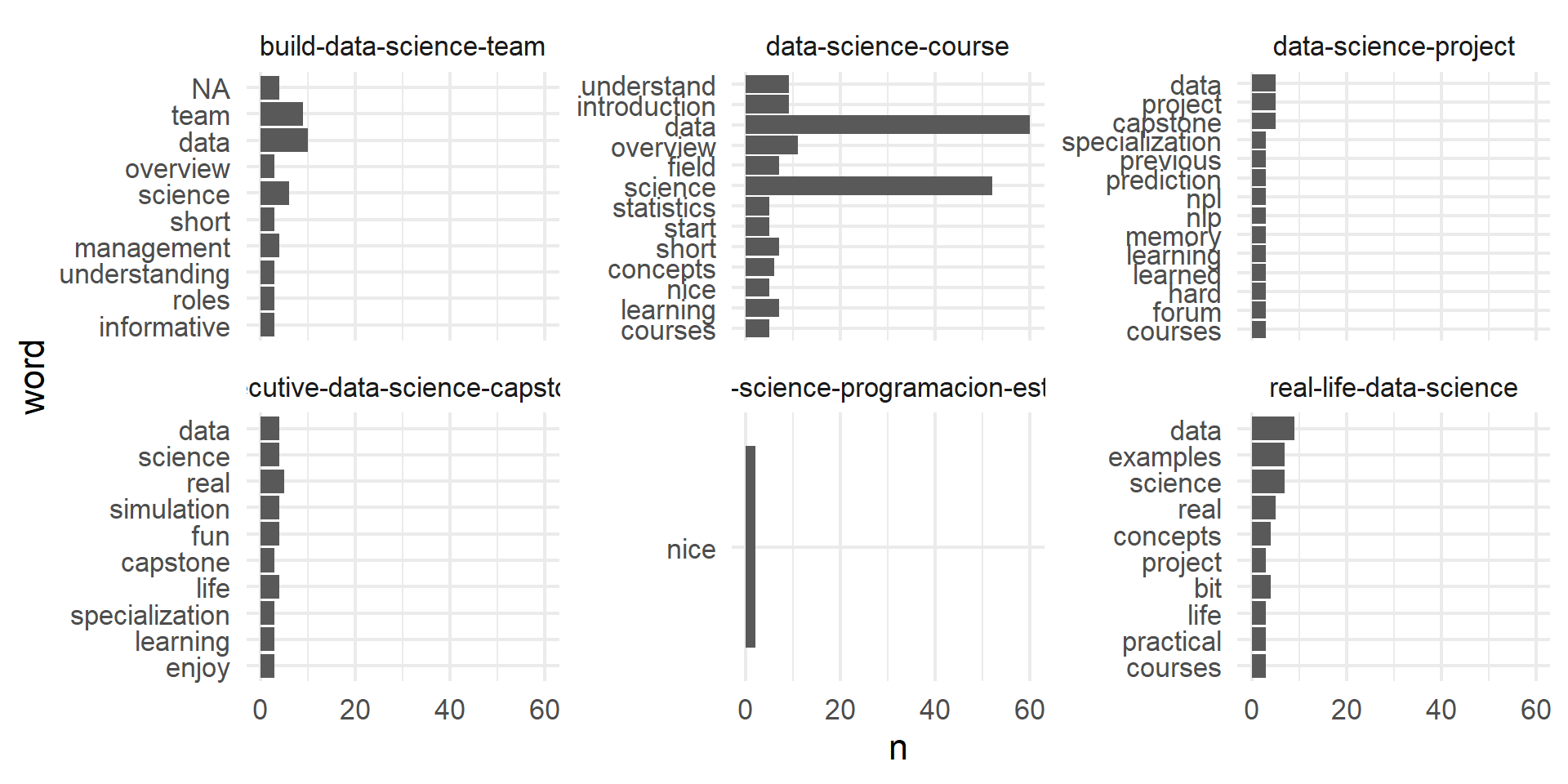
tokens on clean reviews
en_coursera_reviews |>
  left_join(coursera_reviews, by = c("CourseId", "review_id")) |>
  filter(str_detect(CourseId, "data-science")) |>
  unnest_tokens(word, review_clean, token = "words") |>
  group_by(CourseId) %>%
  count(word) %>%
  slice_max(n, n = 10) %>%
  filter( n > 1) %>%
  ggplot(aes(x = n, y = fct_reorder(word, n))) +
  geom_col() +
  facet_wrap(~CourseId, scales = "free_y", nrow = 2) +
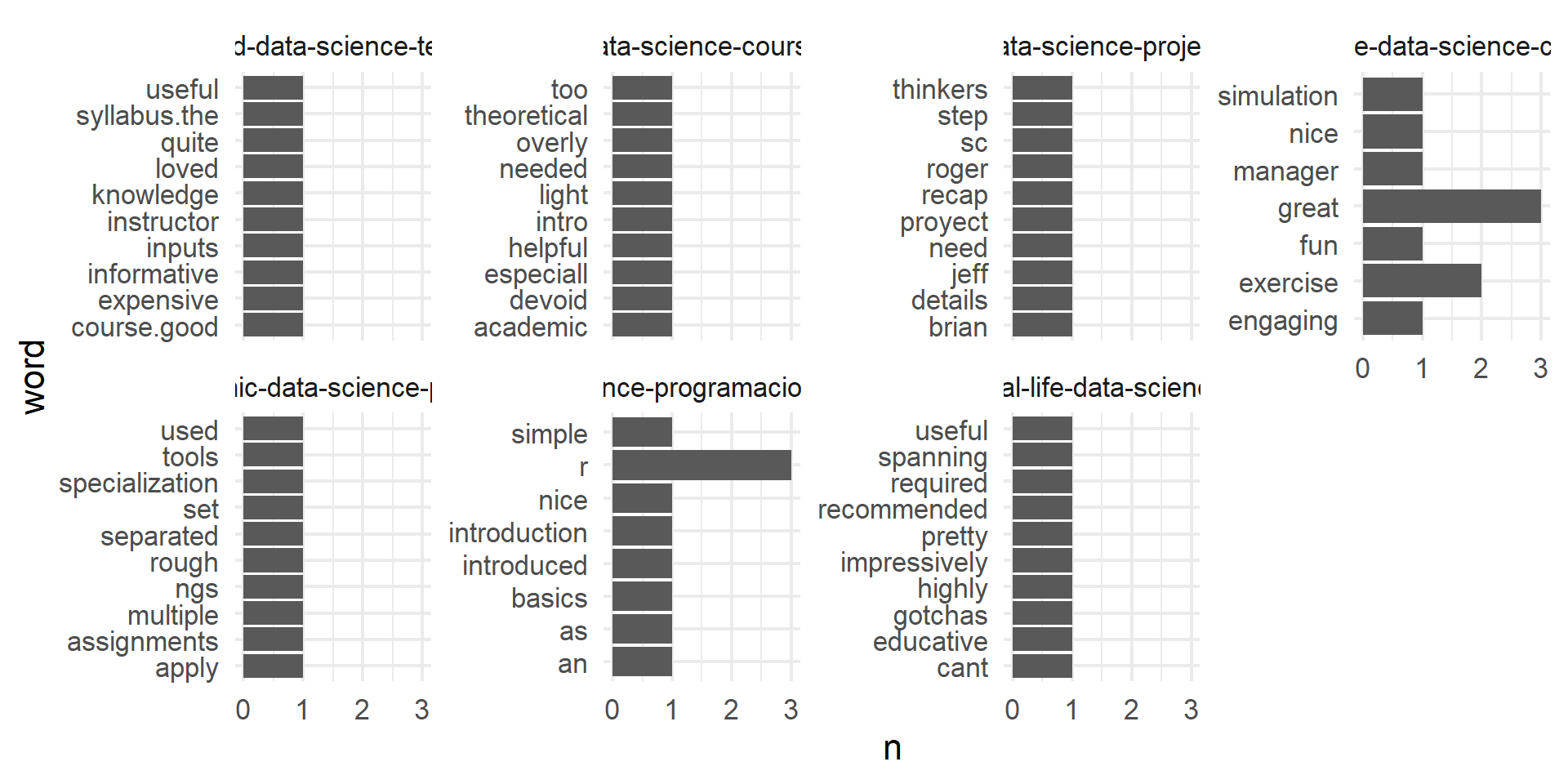
  labs(y = "word")
tokens on clean reviews
Make it ~ fancy ~: tf-idf
Idea: how common are certain tokens relative to the rest of the documents in the corpus?
tf(t,d) = “term frequency”: what proportion of document d is term t?
idf = “inverse document frequency”: log-scaled inverse fraction of documents that contain the term
\[\text{idf} = \log \frac{\text{number of documents in corpus D}}{\text{number of documents containing term t}}\]
\[\text{tf-df(t, d)} = \text{tf(t, d)} \times \text{idf(t, D)}\]
highest tf-idf’s are used a lot within a review, and rarely in other reviews
# A tibble: 547,541 × 7
   review_id word             n    tf   idf tf_idf total_n
       <dbl> <chr>        <int> <dbl> <dbl>  <dbl>   <int>
 1      3970 excellen         1     1 10.2   10.2        1
 2      5501 estupendo        1     1 10.2   10.2        1
 3     25198 excellant        1     1  9.51   9.51       2
 4     10057 impeccable       1     1  9.10   9.10       3
 5     13780 satisfactory     1     1  8.59   8.59       5
 6     26553 magnificent      1     1  8.12   8.12       8
 7      7751 excellence       1     1  7.90   7.90      10
 8     10971 excellence       1     1  7.90   7.90      10
 9     12755 recomendable     1     1  7.90   7.90      10
10     13077 excellence       1     1  7.90   7.90      10
# ℹ 547,531 more rows
en_coursera_reviews |>
unnest_tokens(word, Review) |>
count(CourseId, review_id, word) |>
bind_tf_idf(word, review_id, n) |>
filter(str_detect(CourseId, "data-science")) |>
group_by(CourseId) %>%
slice_max(tf_idf, n = 10) %>%
ggplot(aes(x = n, y = fct_reorder(word, n))) +
geom_col() +
facet_wrap(~CourseId, scales = "free_y", nrow = 2) +
labs(
y = "word"
)
Your turn
Explore the en_coursera_reviews dataset with the folks around you. Can you replicate my analyses, and try a few of your own? Here are some ideas:
- Explore another subject (besides
data-science) Labelcontains the numeric rating for the course. How does the review text differ between highly rated and low-rated courses?stopwords::stopwords_getsources()gives the available stopword dictionaries. How do these differ, and how do they change your results?